
What the customer needs
There are c.1.5bn motorized vehicles on the world’s roads in 2016, with 2Bn predicted by 2035. 72m cars were produced globally in 2018 and this is predicted to rise to about 100m by 2035 and 125m by 2040, mainly due the increase in car ownership in developing nations such as China, India, Russia and Brasil (BRIC countries). For the average global customer, pure electric vehicles (EVs) do not and cannot compete with conventional vehicles which cost half as much and have double the range. This is especially true for heavy-duty vehicles such as trucks, planes and boats. )
Much attention is focussed on reducing battery costs and developing longer range pure electric vehicles (200 mile+). This partially solves the barrier of limited range but it does not solve the barriers of cost, charging infrastructure and reduced performance/ utility. Even assuming battery prices of $100/kWh by 2030, a 100kWh battery would add $10k to the vehicle’s cost and would weigh >500kg, reducing the vehicle’s utility. For reference, the energy density of state of the art lithium-ion batteries, at 100–250 Wh/kg, is x65 lower than for liquid fuels (gasoline 12.9kWh/kg).
To make electric vehicles cost-effective we have to understand "How much battery power do we really need?" and the answer is found in looking at how the vast majority of vehicles on the road are actually driven.
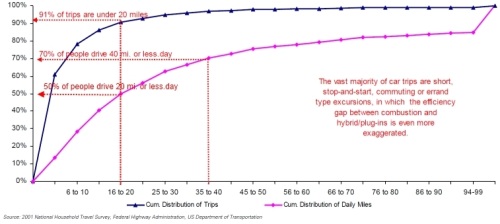
Fig 1. US National Transportation Survey – Average Daily Driving Distance
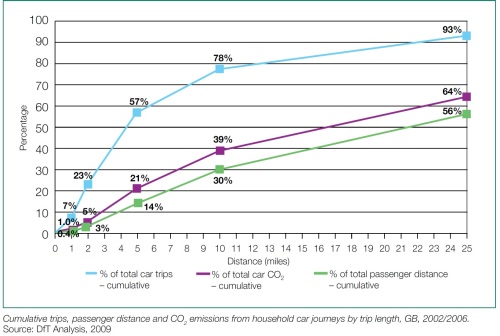
Fig 2. UK Average Daily Driving Distance and CO2 emissions
The two graphs above show that in the US and the UK, like most other countries in the world, the majority of car use is for relatively short distance urban driving, under 25 miles per day. It is in urban driving conditions that speeds are slow, engine efficiency is lowest and pollution from cars is highest. Therefore it makes most sense economically and environmentally to provide a battery just sufficient for average urban driving.
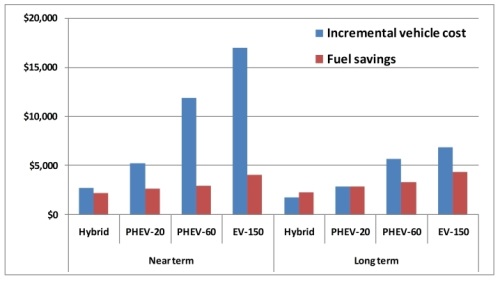
Fig 3. IEA xEV Cost estimates
The International Energy Agency forecasts 35m hybrid (HEV) and plug-in hybrid (PHEV) global sales pa by 2025 and 75m by 2035 - CAGR 20% .
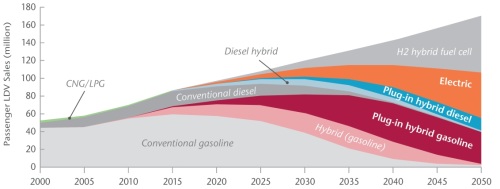
Fig 4. IEA forecast for xEVs
"The Libralato engine is an enabling technology for cost competitive range-extended electric vehicles; which use c.8kWh for 40km of urban driving – the global average daily driving distance – and a highly efficient, low emission, Libralato engine range-extender for high speeds and long distances. Due to its size, weight and cost reductions, the Libralato engine makes space for and subsidizes the other EV components in standard engine bays. Therefore any car model could be produced as an EV, reducing fuel consumption by >70% and CO2 by >65% to 45g/km. The RE-EV system is cost neutral compared to a diesel engine (plus aftertreatment) and delivers 60% fuel cost savings year-on-year (including the cost of electricity). The Libralato R6 eco-engine enables a mass transition to affordable electrified vehicles; globally."